Most lists of good assets vs bad assets sort things by type: stocks good, cars bad, done. That’s a shortcut, and it breaks on the first real example. An apartment can be either. So can a car, a plot of land, or a pile of cash. What decides it is not what the thing is, but which way its money flows each year.
This post explains one simple rule for that, why price is the wrong test, and how to track net worth in a way you’ll actually keep doing. It is educational, not investment advice: nothing here tells you what to buy or sell.
Assets vs liabilities: the popular version
The idea most people have heard comes from the book Rich Dad Poor Dad by Robert Kiyosaki. Its framing, roughly: an asset puts money in your pocket, a liability takes money out. By that logic, the house you live in is a liability, even if the bank and your accountant call it an asset.
The framing sticks because it points at something true. A lot of people feel rich on paper and poor on the 28th of the month. Their “assets” are mostly things that cost money to keep.
It also causes confusion. In accounting, a liability is a debt: a mortgage, a loan, a credit card balance. Calling your home a liability mixes two questions:
- What do you own and what do you owe? That’s your net worth: assets minus liabilities.
- Which of the things you own pay you, and which cost you? That’s the direction of cash flow.
MoneyFlux keeps these two questions apart. Your home stays an asset and counts in your net worth, because it has a value and you could sell it. Your mortgage is a liability. Then, separately, every asset gets a verdict on direction: good capital or bad capital.
The rule: annual income minus annual holding cost
For each thing you own, ask two questions:
- What does it bring in per year? Rent, interest, dividends, payments from someone using it.
- What does it cost to hold per year? Maintenance, insurance, taxes, fees, utilities you pay because you own it, storage.
Subtract the second from the first.
- Positive: good capital. It puts money in your pocket.
- Negative: bad capital. It takes money out.
There are two verdicts and no neutral middle. In MoneyFlux the asset’s class only breaks an exact tie, when income and cost are equal.
The same apartment, twice
This is the example that makes the rule click. Take one apartment at one price.
- Rented out: after costs it earns you about 1,800 a year. Good capital.
- Lived in: it earns nothing and costs about 1,400 a year to hold. Bad capital.
Same walls, same price tag, opposite sign. Nothing about the apartment changed. What changed is the direction of its money.
Other common examples
| What you own |
Usually brings in |
Usually costs to hold |
Typical verdict |
| Apartment you rent out |
Rent |
Repairs, tax, insurance, vacancy |
Good, if rent covers costs |
| Apartment you live in |
Nothing |
Repairs, tax, insurance, utilities |
Bad |
| Car for personal use |
Nothing |
Insurance, service, parking, fuel |
Bad |
| Car you rent out or use for paid work |
Income from it |
Same costs, often more |
Depends on the numbers |
| Savings deposit |
Interest |
Usually little or nothing |
Good |
| Cash at home |
Nothing |
Nothing |
Tie: the class decides |
| Pension account |
Growth, not cash in hand |
Fees |
Depends on how you count growth and fees |
“Typical” matters. The rule only works if you put in your own numbers. Your rented apartment might have a bad tenant and a leaking roof; your “bad” car might carry your work.
Expensive is not good
The most common mistake is to treat price as quality. A car worth $100,000 is still bad capital if all it does is cost money to insure and service. A bigger apartment you live in is usually more bad capital, not less, because it costs more to hold.
Price tells you what you could sell something for. It says nothing about direction. That’s why a net worth figure on its own can feel so far from your monthly reality: a rising number can sit on top of a growing yearly drain.
Bad capital is not bad
The opposite mistake is to hear “bad capital” and start selling things. Don’t. A home gives you somewhere to live that no landlord can take away. A car gets you to work and your kids to school. A deposit can’t do either of those.
The point is not to drive bad capital to zero. It’s to know the share. If good capital earns more each year than bad capital costs, your things are paying for themselves. If not, you know where the monthly squeeze comes from, and any decision you make about it is yours, with real numbers in front of you.
How to track net worth without it becoming a chore
The reason most people track net worth once and never again is the re-entry. Every quarter you’d have to list everything again and look up every value. Here’s a routine that avoids that.
Step 1: list what you own and owe, once
Write down every asset with four facts: its current value, what it brings in per year, what it costs to hold per year, and its currency. Then list your debts. Don’t chase precision. A realistic estimate of what the apartment would sell for is enough.
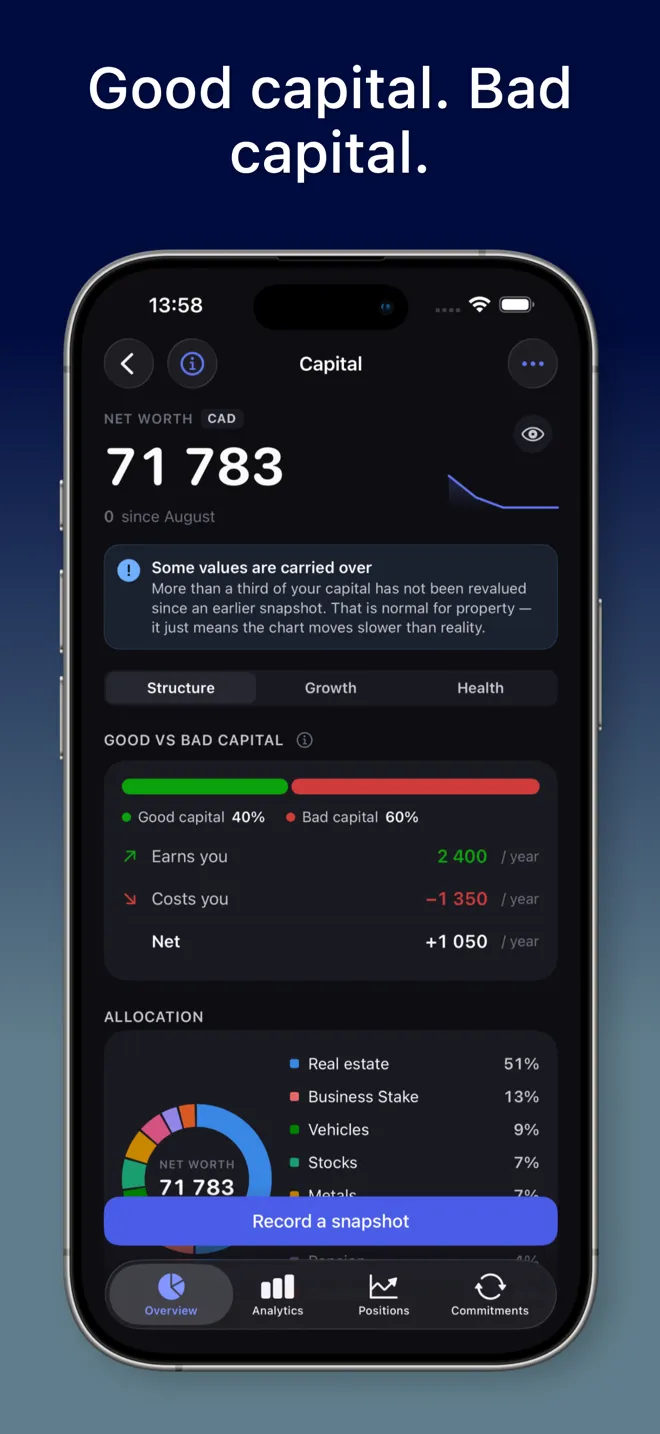
In MoneyFlux this is the Capital screen, under Overview. Assets are grouped into classes (real estate, currency, stocks, metals, crypto, vehicles, pension, or your own), and each one has a value, what it earns, what it costs to hold, a risk level, a purpose and how quickly it turns into cash. As you type the earnings and costs, the good or bad verdict updates live. If you mark something as good capital while the arithmetic says it costs you money, the app points that out, and you can change it or keep your choice. The asset list is free.
Step 2: revalue once a quarter
Property, pensions and cars don’t change meaningfully week to week. Checking more often mostly adds noise, and noise tempts you into decisions that cost more than they save. Four times a year is a sensible rhythm.
In MoneyFlux, a snapshot (Premium) pre-fills every asset with its last value, so you only edit what moved. If you added or withdrew money, you mark it, so a deposit you made doesn’t show up as “return”. The summary shows previous and new net worth, what changed in your good-capital share, and the largest mover. You can set a reminder monthly, quarterly, every six months or yearly.
Step 3: read the direction, not just the total
After a few quarters, three numbers matter more than the headline:
- Good vs bad share. Is the part of your wealth that pays you growing or shrinking?
- Net yearly cash flow. What everything earns minus what everything costs, per year.
- Runway. How many months your liquid reserves would cover your living costs.
MoneyFlux shows these on the Capital screen: the Structure view with earns, costs and net per year, the Growth view with net worth over time and contributions kept out of returns, and the Health view with a safety runway in months and how many times good capital’s earnings cover bad capital’s costs. Snapshots, growth, health and risk targets are Premium. The Capital section on the features page lists all of it.
Try it in MoneyFlux: add your home and your car to Capital with honest yearly costs, then add one thing that earns. Watch the verdict on each one, and the earns, costs and net row underneath. That one screen usually explains the end-of-month gap better than any total.
What about debts?
Debts are the other half of assets vs liabilities. A mortgage, a car loan, an installment plan, money you borrowed from your brother: each one lowers your net worth, however good your assets are. When you track net worth, don’t skip the liabilities just because they’re unpleasant to look at.
It helps to look at a debt next to what it paid for. A mortgage on an apartment you rent out is serviced from the rent. A loan on a car you drive yourself adds cost to something that already takes money out. In MoneyFlux, liabilities have their own filter in the asset list, so both halves of the picture sit together instead of in different files.
What about several currencies?
If your apartment is in hryvnias and your savings are in Canadian dollars, any single “net worth” needs an exchange rate. Pick the rate on a different day and the total moves without anything you own changing.
MoneyFlux has no exchange rates at all, on purpose. Capital is shown in the currency that holds most of your register, and a note names the assets held in other currencies that it excludes. You see each currency honestly instead of one total built on a rate the app made up. The reasoning is the same as in tracking expenses in several currencies.
Where net worth tracking fits with everyday spending
The direction of your assets explains part of the monthly picture, not all of it. The yearly cost of holding a car shows up in your spending as insurance, service and fuel. If you also want to see those costs as they happen, start with where your money goes every month, and keep your cards, cash and crypto in one ledger with tracking all your accounts in one place. If part of your capital follows someone else’s trading calls, first check that trading signals track record.
Capital answers a slower question: of everything you own, how much is working for you, and how much are you working for? Asked once a quarter, with honest numbers, that question tends to be more useful than any single total.