

Spending
How Much Should I Save Each Month? Find Your Own Number
Every article gives a percentage. Few say what to do when the percentage doesn't fit your rent. Here is how to test a rule against your real month and settle on an amount.
Spending
You have some money set aside for emergencies. Is it enough? A balance alone can't tell you. The number that can is how many months of essentials it would cover.
Opening a savings account takes ten minutes. Knowing whether the number in it is enough takes arithmetic most people skip. Say you have $4,600 put away and want an emergency fund tracker that tells you if it is enough. Whether that’s fine depends on what a month of your life costs, and few people have ever added that up.
Don’t track the balance. Track how many months of essentials it covers. Below: how to find that number, pick a target, and follow it on your iPhone. The figures are invented, and this isn’t financial advice.
Three numbers are enough:
The third is the one people skip. At $1,500 a month of essentials, $4,600 is three months. At $3,000 it’s one and a half. Same balance, very different position.
Essentials are the costs that keep running if your income stops. Think of the cheapest version of a normal month:
Leave out what you would cancel in a crisis: streaming, eating out, trips, shopping. Subscriptions are the usual place to find a few of these; listing your recurring payments takes about ten minutes.
Estimates from memory come out low, because irregular costs don’t come to mind: the car repair, the annual premium, the school fees. Pull the last three months of transactions and total the essential categories for each. Then take the highest of the three, so a bad month sets the bar. If you’re unsure how to read the categories, this walkthrough of where your money goes shows the review.
Here is an invented example:
| Essential | Per month |
|---|---|
| Rent | $1,400 |
| Groceries | $450 |
| Utilities and internet | $180 |
| Insurance | $120 |
| Transport | $100 |
| Phone | $50 |
| Total | $2,300 |
With $4,600 saved, that fund covers $4,600 ÷ $2,300 = 2 months. Two months is worth having. It’s still short of the usual target, though. One big repair plus a slow job hunt would drain it.
The range you will see most often is three to six months of essentials. That’s a rule of thumb, not a law. A household with two steady incomes can reasonably sit near the low end. A freelancer, a single earner or someone in a layoff-prone industry usually wants more, because looking for work can take longer than a few weeks.
If three months feels far away, start with a smaller step. A first goal of $1,000, or one month of essentials, still covers a lot of ordinary emergencies, and you can raise the target later. If your income swings from month to month, aim for the high end and size your essentials from your leanest-income months. The post on how much to save each month covers the order of emergency cushion and other goals.
With the example above:
The gap to three months is $6,900 − $4,600 = $2,300. Divide by what you can put in:
Pick the amount you can really manage in your leanest month, not your best one. Put in $300 for two months and quit, and you’ve saved $600. $150 a month for a year is $1,800. For more on that calculation, see the savings goal calculator walkthrough.
Keep it somewhere you can reach within a day or two, and somewhere that isn’t your everyday card. A separate savings account is the usual choice, because it creates a small pause before the money gets spent. Rates and rules differ by bank and country, so check your own bank’s terms rather than relying on a general claim.
Keep the fund in the currency of your expenses. If you earn and spend in one currency, hold it in that one.
A notes app is fine for the first month: one line, “Emergency fund: $4,600, target $6,900”. It breaks the first time you forget to update it.
A spreadsheet is better. One row for the fund, a column for months covered, a formula that divides balance by essentials. The weak spot is upkeep: you edit it by hand every time money moves, and the essentials figure goes stale. The spreadsheet versus app comparison covers where that pays off.
An app helps mainly because your spending and your fund sit in one place, so the check is quick. MoneyFlux is one such app, with limits that come next.
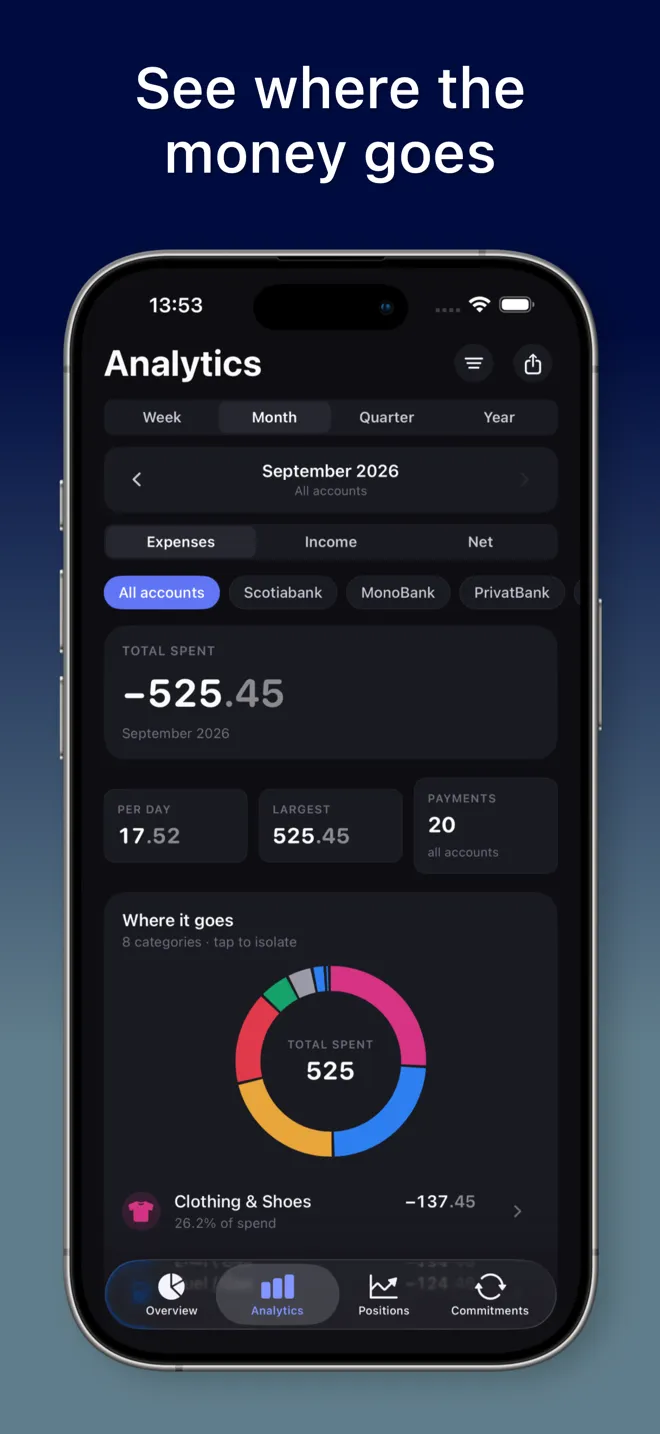
MoneyFlux has no feature named “emergency fund”, and it isn’t a budgeting app. What it has is savings goals, and a goal without a deadline does the job. Savings goals are free.
The setup:
If you set a savings target as a share of your income in Settings, MoneyFlux turns this month’s real income into an amount to put away, and can offer to split your salary across several goals. There’s an optional reminder on the 25th for people who save after payday.
Try it in MoneyFlux: total last month’s essential categories in Analytics, create a goal called “Emergency fund” at three times that amount, and add what you have today. Then divide the balance by the monthly total to get your months covered.
The bank statement import page explains which banks and file types work, if you’d rather not type three months of transactions.
A few things to do once the fund exists:
Add up a month of essentials, divide your balance by it, and write the result down. In six months, do it again.
Three things: the current balance, the target, and how many months of essential spending the balance covers. The last one is the useful one, because it tells you how long you could cope without income.
Keep the money in one place, record every deposit and withdrawal, and divide the balance by your essential monthly spending. A spreadsheet row, a notes-app line or a savings goal in an app all work, as long as you update it when money moves.
Three to six months of essential expenses is the range you will see most often. A single earner, a freelancer or someone in a shaky industry usually aims higher. Starting with a smaller amount, say one month, is fine.
It can, but it does not need one. A deadline turns the target into a monthly amount, which helps if you want a finish line. Without one, you simply keep adding until the months-covered number looks right.
Yes. Create a savings goal for it, in the currency you hold the money in, and put money in from a card. Savings goals are free. MoneyFlux records what you set aside; it does not transfer money between your bank accounts.