Most answers to “how much should I save each month” come down to one number: 20% of what you earn. For someone with $3,400 a month after tax, that is $680. If rent already takes $1,800 of it, $680 may not exist.
Hold off on the 20% for now. First the rules people quote, then a test against your own last three months. The app comes last. None of this is financial advice, and the figures are made up, so use your own.
The rules people quote
Capital One’s guide calls 20% of take-home pay the rule of thumb and works it out for several salaries. Bankrate gives a slightly different one: 15-20% of gross pay, counting retirement contributions and any employer match, with 5-10% as a start for lower earners. Bankrate also describes 50/30/20, where take-home pay splits into 50% for needs, 30% for wants and 20% for savings and debt repayment. That last one is usually credited to Elizabeth Warren’s 2005 book All Your Worth. Note the 20% in 50/30/20 includes debt repayment, so if you pay down a card or a loan, part of your 20% is already spoken for.
They overlap more than they look. If tax and deductions take a quarter of your pay, 15% of gross is exactly 20% of take-home. Pick the version that matches the numbers you can actually see. Your bank balance shows take-home pay, so that is the easier one.
Why a rule can miss
20% is an average. It knows nothing about your rent, a loan that ends in spring, or a paycheck that swings by a third. If you can’t reach 20%, look at rent and pay before you blame yourself.
Measure your real month first
Before choosing a percentage, find out what a normal month looks like. It takes about half an hour.
- Pull the last three months. Income in, spending out, for every account you use. One odd month won’t skew three.
- Mark transfers. Money you moved to your own savings or another card is not spending. Counting it twice makes everything look worse than it is.
- Split fixed from flexible. Rent, loan payments, insurance and subscriptions are fixed. Groceries, eating out and fun are the flexible part.
- Check the yearly bills. Car insurance or a holiday trip doesn’t show up in a typical month, but it is in your year. The post on sinking funds covers turning those into a monthly amount.
- Subtract. Income minus fixed costs minus a realistic figure for the flexible ones is what you can save. If it comes out at zero or less, saving isn’t the problem yet. Cut the biggest fixed cost or the flexible category that has grown most. Then set up a $25 transfer so the habit exists.
If you’ve never done the review, where your money goes every month walks through it in more detail.
Turn the result into a number
Compare what step 5 gave you with the rules.
Say take-home pay is $3,400 and fixed costs are $2,300. You spend about $700 on the flexible side. That leaves $400, or about 12%, which is under the 20% rule ($680).
You have $400 and the rule says $680. Three ways to narrow that:
- Save $400 and accept 12%. Reasonable, especially if the alternative is quitting in February.
- Trim the flexible $700. Cutting $100 from eating out and delivery lifts you to $500, about 15%. Pick one category, not all of them.
- Raise income or lower a fixed cost. Slower, but it is the only route to a real jump. A cheaper phone plan or a renegotiated insurance bill counts.
I’d save the $400 and trim one category, delivery say, by $50. Leave rent and the phone plan alone for now. If a surprise $200 bill would make you skip a month, $400 is too high; go to $300.
If you carry high-interest card debt, paying it down usually comes before saving beyond a small cushion. Take any employer retirement match first, because skipping it leaves part of your pay unclaimed.
If your income is irregular
Base the monthly amount on your lowest typical months. In good months, put the extra in as a separate deposit. Bankrate suggests people with variable income aim for the higher end of the emergency-fund range. A bad month hits harder when pay swings.
Emergency fund first, or the goal first?
Bankrate’s advice is to start with at least $1,000, then build toward three to six months of essential expenses. Before that is in place, a trip fund is the thing you’ll raid. Keep the order: a small emergency cushion, then your named goals.
Pay yourself first
Move the savings amount on payday, before you spend anything, and pay the bills from what’s left. Whatever is left over rarely survives a tight month.
If your bank lets you schedule a transfer for the day after your salary lands, do that once and stop deciding monthly.
Checking the number in MoneyFlux
MoneyFlux isn’t a budgeting app. There are no category limits. What it has for this question:
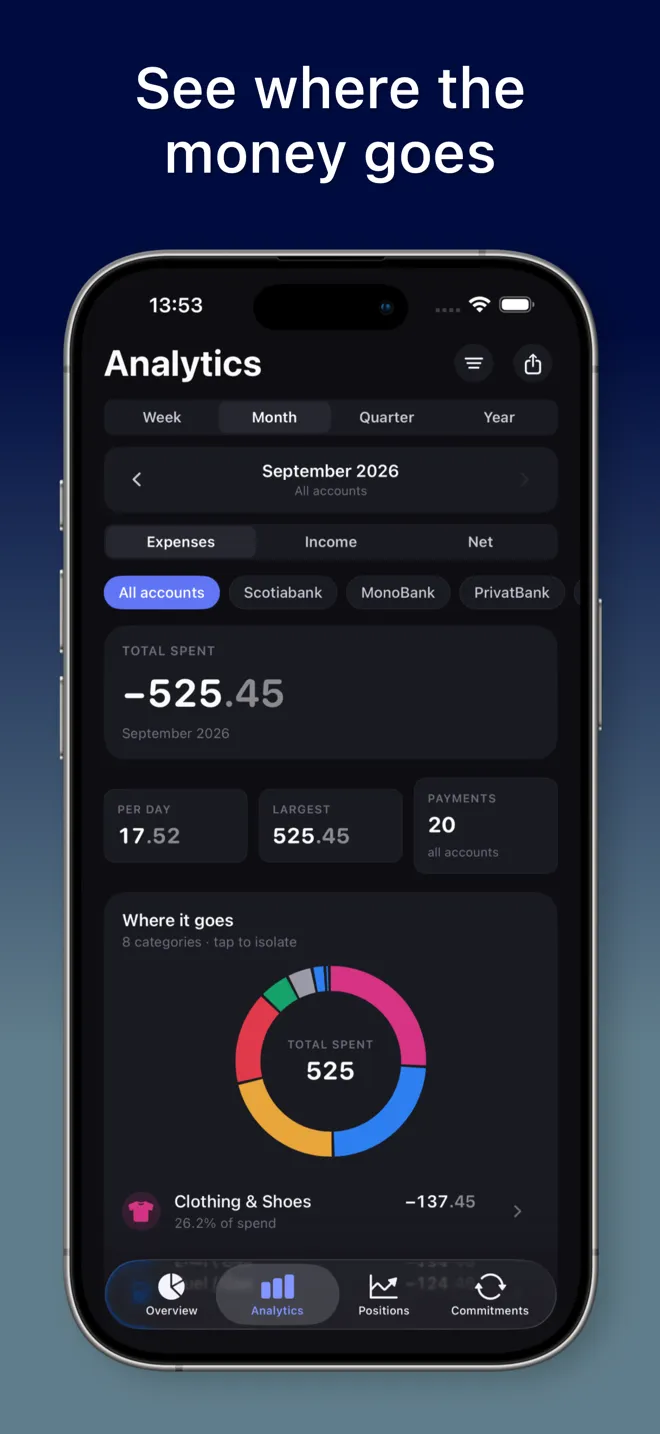
- Expenses, Income and Net for any period, so step 1 and step 5 above take a minute instead of an evening, once your transactions are in.
- A savings target as a share of your income. Set a percentage in Settings and the app turns this month’s real income into an amount to put away. The Net view shows your actual savings rate for each period against that target.
- Savings goals. They’re free. Each has an amount, an optional deadline and money going in from a card, and the app shows the monthly amount and expected finish date at your current pace. It can offer to split your salary across several goals and remind you on the 25th.
- Statement import to get the data in without typing. The bank statement import page lists the banks and file formats. The first import is free, then it’s Premium.
Try it in MoneyFlux: import last month’s statement, mark your transfers to savings as transfers, and open Net. If your savings rate comes in under your target, lower the target to something you can hit and try again next month. See savings goals for how goals and the target work together.
What it doesn’t do
It doesn’t tell you what to save; the target is yours. It doesn’t move money, so a goal records what you’ve set aside and you make the transfer in your bank. It doesn’t connect to your bank either: you export a statement file and bring it in, and the file is read on your phone. Totals stay per currency, with no conversion.
Review it twice a year
Recheck the number when rent, pay or a loan changes. Run the measuring steps again, and when something frees up, send half of it to savings before it disappears into daily spending. If you track subscriptions, the guide to recurring payments is a quick place to find money you’ve forgotten about.
Frequently asked questions
How much should I save each month?
A common starting point is 20% of your take-home pay. If that's too much right now, begin smaller, even a flat $25 a month, and raise it when a bill ends or your pay goes up. The right number is the one you can pay in a tight month too.
What is the 50/30/20 rule?
It splits take-home pay into 50% for needs, 30% for wants and 20% for savings and debt repayment. It is a rough guide, and in an expensive city the needs share can pass 50% on its own.
Should I save before or after paying bills?
Move the money the day your pay lands, then pay bills from what remains. Saving what's left works in easy months and gets skipped in the hard ones.
How much should I save each month on a low income?
Start with something small and regular, even 1-3% of pay, and build the habit first. A small automatic amount you never skip is worth more than a big plan you abandon.
Can MoneyFlux tell me how much to save?
No. It doesn't give advice. You set a savings target as a percentage of your income, and the app shows your real savings rate for each period against it, so you can see whether the number works.