If you want to know how to stop impulse buying, start with how little time there is to stop. The thing catches your eye, you tap, it is paid for. Nothing in that sequence asks you to decide.
Willpower fails here because there is nothing to push against. Two habits do better: wait, and count what you buy without planning to. Below: both habits, and where MoneyFlux helps. It only helps with the counting.
Why impulse buying is so easy
Cash is slow. You take it out, you hand it over, you see the wallet get lighter. A saved card, a phone tap and one-click checkout remove every one of those steps.
Shops know this. Countdown timers, “only 2 left” labels, free-shipping thresholds and a push notification at 9 p.m. are all there to shorten the gap between wanting and buying. Each trick is minor. Stacked up, they leave you no time to think.
And the purchase is nearly always small. A single $14 impulse buy is easy to defend. That is why the total is the thing to look at: thirty of them in a month is a different conversation.
Find your triggers first
Before changing anything, look back at the last few unplanned purchases and ask three plain questions about each: where were you, what time was it, and what was going on?
Most people find a pattern in a few minutes. Common ones are tired evenings with a phone in hand, a lunch break with nothing to do, walking through a shop “just to look”, scrolling after an argument, or a sale email arriving while the card is already open in another tab. Just note the place and the hour. Those you can change.
Write down your top two. The fixes below work better when they are aimed at those.
Put a wait between the want and the checkout
Keep a wait list
This is the simplest thing that works. Keep a note on your phone called “Waiting”. When you want something you did not plan to buy, don’t buy it and don’t leave it in the cart. Add a line: the item, the price, and the date you will look again.
When the date comes, read the list. Items you have forgotten stay on it or get crossed off. Items you still want get bought, without guilt, because now it was a decision.
How long? Match the wait to the price. A rough scale that many people use:
- Under $10: no wait. Just watch how often it happens.
- $10 to $50: one day.
- Over $50, or anything you’d be annoyed to have wasted money on: a week.
These cutoffs are a rule of thumb, not research. Scale them to your own income. If $50 is a rounding error for you, move every line up.
Add friction where you shop
Friction is anything that makes buying a little slower. You can add it in about ten minutes.
- Remove saved cards from the shops and apps you buy from most. Typing sixteen digits is a small hassle, and the hassle is the point.
- Delete the shopping app you use most and use the browser instead. You lose the notifications and the one-tap checkout, and keep the option to buy when you need something.
- Unsubscribe from sale emails, and switch off notifications from stores. If a sale is real you will see it again.
- Log out after each visit so the next purchase takes a login.
- Use a different payment method for the problem category. If the leak is takeaway, pay for it with a set amount of cash for the week, and see what happens when it runs out. Do this for one category only.
Handle the in-store version
Online shopping has carts; shops have the till. The same idea applies: before you pay for something unplanned, step out of the queue, walk around the block or put the item back and come back in ten minutes. If you still want it, nothing has been lost. If you don’t, you have just saved the price without any effort.
Count what you buy on impulse
The wait list slows purchases down. Counting tells you whether it is working, and it needs a rule you can follow without thinking.
The rule: every purchase you did not plan gets the tag #impulse at the moment you record it. Planned things (groceries on your list, a gift you chose last week) don’t. Be strict about it, even when it feels slightly embarrassing. The count is only useful if it is honest.
Then, once a month:
- Search your transactions for the tag.
- Add up the amounts and note the number of purchases.
- Open the biggest few and ask whether you still use or enjoy them.
Say a month has 19 tagged purchases totalling $340, and seven of them are late-night orders from one app. Fix that app first.
Don’t use the tag to beat yourself up. Some impulse buys are fine. You are after the number, not zero.
How MoneyFlux helps with the counting
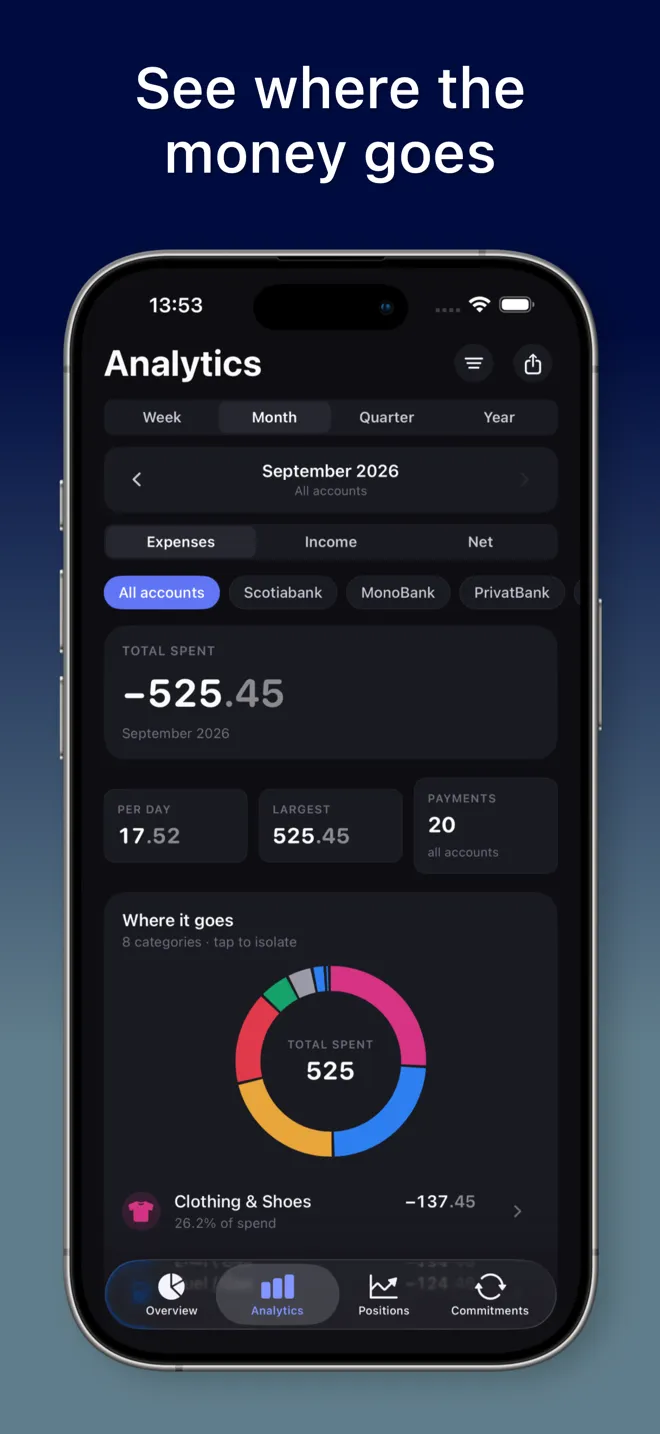
MoneyFlux lets you add a note and a tag to any transaction, including rows from an imported bank statement. On the statement review screen you can recategorize a row, add a tag or skip it before it is saved, so a monthly import is also a natural moment to tag the unplanned ones. The guide to importing a bank statement instead of typing every expense shows how that works. You can search for your tag to see the list. Filtering Analytics by tag is a Premium feature.
For in-store purchases there is a way to catch them at the moment you pay. MoneyFlux has a Shortcuts automation for iPhone that logs a contactless Apple Pay payment right after the tap, with amount, merchant and card, tagged #applepay. It covers in-store contactless payments only, not online orders, and you set it up once. The steps are in the guide to logging Apple Pay purchases automatically with Shortcuts. The logged purchase then sits in your list for you to add #impulse to if it was one.
Online orders and card payments outside Apple Pay come in with the next statement import. If you import weekly instead of monthly, you can see the tagged total while there is still time to change the month.
Try it in MoneyFlux: open your last statement import, find three purchases you did not plan and add the tag #impulse to each. Next month, add up that tag and compare.
What this won’t fix
A tracker can’t stop you paying. MoneyFlux shows what you spent; it does not set budgets, block purchases or send spending alerts. The wait list and the friction do the stopping, and they only work if you keep using them.
One tagged month is thin evidence. A trip, a birthday or a broken phone can swamp everything, so look at two or three months before you decide the habit has changed.
If the buying is a way of coping with stress or low mood, feels out of your control, or is putting you into debt, a few tricks are not enough. A doctor or a financial counselor is a better first call.
Where the money goes instead
Money you stop spending needs a destination, or it leaks back out. The savings goal calculator guide shows how to turn “a bit more saved” into an amount and a date, and savings goals in MoneyFlux are free. If the problem is wider than impulse buying, the guide to how to stop overspending covers finding the category where the whole month leaks.
This is general information, not financial advice.
Frequently asked questions
Why can't I stop impulse buying?
Usually because the purchase is built to be fast: one tap, a saved card, a countdown timer, a notification at the wrong moment. If wanting something and paying for it happen seconds apart, there is no point where you decide. Adding a wait or an extra step puts that point back.
How long should I wait before buying something?
A day is the common starting point, and it is a rule of thumb rather than a proven number. A sensible version is to scale it to the price: no wait for small everyday things, a day for a mid-sized item, a week for anything you would be sorry to have bought.
Does deleting shopping apps help?
For many people, yes, because it removes the notifications and the one-tap checkout. You can still shop in a browser when you really need something, which is the extra step that matters.
Can an app stop me from impulse buying?
No app can stop you paying. A tracker can show you the total sooner and make each unplanned purchase visible. MoneyFlux does that, but it does not block purchases, set budgets or send spending alerts.
What if I buy things to cope with stress or low mood?
Habits and tricks help with the ordinary kind of impulse buying. If you buy compulsively, feel unable to stop, or the spending is causing debt, speak to a doctor or a financial counselor. A tracker is the wrong tool for that.